
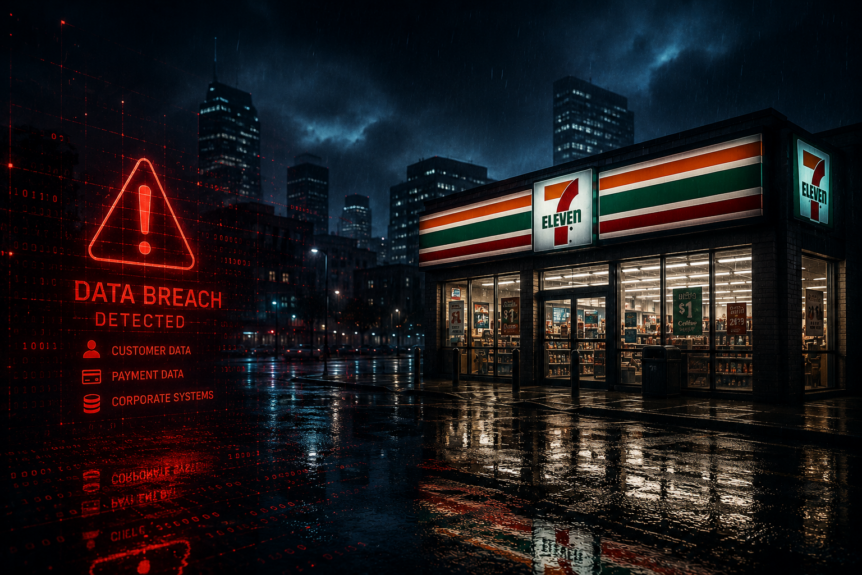
When most business owners hear about a cyberattack involving a major brand like 7-Eleven, the first reaction is often, “That would never happen to us.”
The reality is that cybercriminals do not choose victims based solely on size. They look for opportunities. Whether a company has 10 employees or 100,000, attackers are constantly searching for weak access controls, unmonitored accounts, and overlooked security gaps.
The recent cyber incident involving 7-Eleven serves as another reminder that cybersecurity is not just about preventing attacks. It is about reducing opportunities for attackers and limiting damage when something goes wrong.
The Common Thread in Many Breaches
Every cyberattack is different, but many share a similar theme: access.
Once an attacker gains access to an account, application, or system, they often begin moving through the environment looking for sensitive information, privileged accounts, and additional opportunities.
In many cases, the breach itself is not caused by advanced hacking techniques. It can be the result of:
- Unused accounts that were never removed
- Weak passwords
- Missing multi-factor authentication (MFA)
- Excessive user permissions
- Third-party integrations that are not regularly reviewed
- Poor visibility into who has access to what
Cybersecurity is often less about stopping a Hollywood-style hacker and more about managing access effectively across the organization.
Why Access Reviews Matter
Most businesses spend time deciding who should have access to systems.
Far fewer spend time reviewing who actually has access.
Over time, organizations naturally accumulate risk:
- Former employees retain access
- Vendors receive permissions that are never removed
- Users are granted administrative rights they no longer need
- New software integrations are connected without proper oversight
These small issues can quietly create significant security exposure.
Regular access reviews help identify these risks before they become a problem.
The Importance of Multi-Factor Authentication
One of the most effective security controls available today remains multi-factor authentication (MFA).
Even if a password is stolen, MFA creates an additional barrier that can prevent unauthorized access.
Businesses should prioritize MFA for:
- Email accounts
- Microsoft 365 environments
- Cloud applications
- Financial systems
- Remote access tools
- Administrative accounts
While MFA is not a complete security strategy, it significantly reduces the likelihood of account compromise.
Third-Party Risk Is Growing
Modern businesses rely on dozens of applications, integrations, and service providers.
While these tools improve productivity, they also expand the attack surface.
Every connected application introduces another potential pathway into the business.
Organizations should regularly review:
- Connected applications
- Vendor access
- API permissions
- Data-sharing configurations
- Unused integrations
The goal is simple: if a connection is not necessary, remove it.
Five Questions Every Business Should Ask Today
The 7-Eleven incident provides a good opportunity for business leaders to review their own security posture.
Ask yourself:
- Do we know who has access to every critical system?
- Have former employees been completely removed?
- Is MFA enabled everywhere it should be?
- Are administrative privileges limited to only those who need them?
- Do we regularly review third-party access and integrations?
If any of these questions are difficult to answer, it may be time for a security review.
Cybersecurity Is About Preparation
No business can guarantee that it will never experience a cyber incident.
What organizations can do is reduce risk, improve visibility, and prepare for potential threats before they occur.
Strong cybersecurity is not built around a single tool or product. It comes from consistent processes, ongoing monitoring, access management, employee awareness, and proactive planning.
The companies that perform best after an incident are usually the ones that prepared before it happened.
Final Thoughts
The recent 7-Eleven cyberattack is another example of why cybersecurity remains a business issue, not just an IT issue.
Every organization should regularly review who has access to systems, where sensitive information is stored, and how security controls are being maintained.
The question is not whether cyber threats exist.
The question is whether your business is prepared when they arrive.
Need Help Reviewing Access?
Engler IT helps businesses identify security gaps, review user permissions, strengthen access controls, and improve overall cybersecurity readiness.
Schedule a FREE IT Risk Assessment and see what cybercriminals can see before they do.