
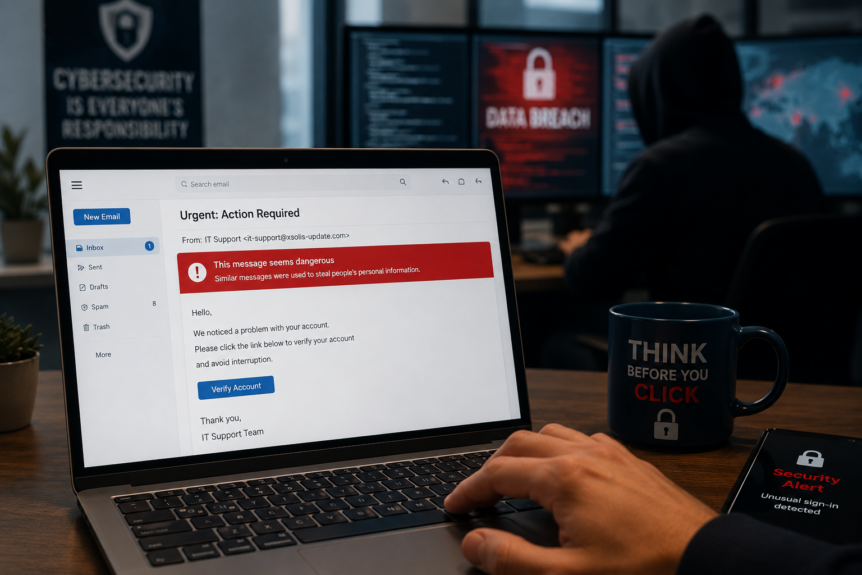
When people think of a major data breach, they often picture a hoodie-wearing hacker breaking through a firewall in the middle of the night.
But in many cases, the front door is much simpler.
A recent breach involving Xsolis, a U.S.-based healthcare technology company, is another reminder that cyberattacks do not always start with complex code. Sometimes, they start with one convincing email.
According to the company’s public notice, Xsolis discovered unauthorized activity in part of its environment on January 22, 2026, after a targeted phishing attack two days earlier. The company stated that an unauthorized actor acquired files that may have contained personal and protected health information, including names, addresses, dates of birth, health insurance information, Social Security numbers, and medical treatment information.
Reports indicate that nearly 1.4 million individuals may have been affected.
That is not “just an IT problem.”
That is a business problem. A trust problem. A compliance problem. A customer confidence problem.
And it is exactly why phishing remains one of the most dangerous threats facing organizations today.
The Breach Started With Phishing
Phishing attacks are designed to trick employees into doing something that helps an attacker gain access. That could mean clicking a link, entering a password, downloading an attachment, approving a fake request, or unknowingly giving away access to a system.
The scary part is that phishing does not need to fool everyone.
It only needs to fool one person.
Once attackers gain access, they may move quickly through systems, search for valuable data, steal files, create new access points, or prepare for a larger attack. In the case of Xsolis, the company said it took action to contain the activity, terminated unauthorized access, isolated affected hosts and user accounts, and brought in outside cybersecurity experts.
Those are important response steps.
But the bigger lesson for every business is this: prevention matters before the breach happens.
Why This Breach Matters to Every Business
You do not need to be a healthcare company to learn from this incident.
Every business has sensitive information. Employee records. Customer data. Financial files. Vendor contracts. Login credentials. Bank details. Insurance documents. Internal emails. Strategic plans.
Attackers do not care if you are a hospital system, accounting firm, construction company, nonprofit, school, law office, or local service business.
If your data has value, your business is a target.
And if your employees use email, your business is exposed to phishing.
The Xsolis breach is a strong reminder that cybersecurity is not only about having tools in place. It is about making sure those tools, policies, people, and processes work together.
What Businesses Should Be Asking Right Now
After a breach like this, business owners and leaders should not simply think, “That happened to them.”
They should ask:
Are our employees trained to spot phishing emails?
Do we use multi-factor authentication on all critical accounts?
Can we detect suspicious logins quickly?
Do we know who has access to sensitive data?
Are old user accounts still active?
Are our vendors protecting the data we share with them?
Do we have a real incident response plan, or just hope and good intentions?
These questions matter because attackers are counting on gaps. They are counting on rushed employees, weak passwords, reused credentials, outdated systems, and businesses that assume “we’re too small to be a target.”
That assumption is dangerous.
Cybersecurity Is Not Just About Stopping Attacks
No security plan can promise that nothing will ever happen.
The goal is to reduce risk, limit access, catch suspicious behavior early, and make sure one mistake does not turn into a company-wide crisis.
That means businesses need layers of protection, including:
Multi-factor authentication
Email security and filtering
Employee phishing awareness training
Endpoint protection
Access controls
Vendor risk reviews
Data backups
Password management
Security monitoring
Incident response planning
When these layers are missing, a single phishing email can become a much bigger problem.
The Bottom Line
The Xsolis breach is another reminder that phishing is not old news. It is still one of the most effective ways attackers get inside an organization.
And once they are inside, the damage can move fast.
Your employees are your first line of defense, but they should never be your only line of defense.
Engler IT helps businesses strengthen their security, reduce risk, and build smarter protection before attackers find the gaps.
Because the best time to prepare for a cyberattack is before the email lands in someone’s inbox.